
Life Sciences Overview: Demand Strong, Capital Weak
Medicine demand and contract manufacturing are strong, but biotech funding and R&D productivity are weak, and tools are soft. Life sciences is split.
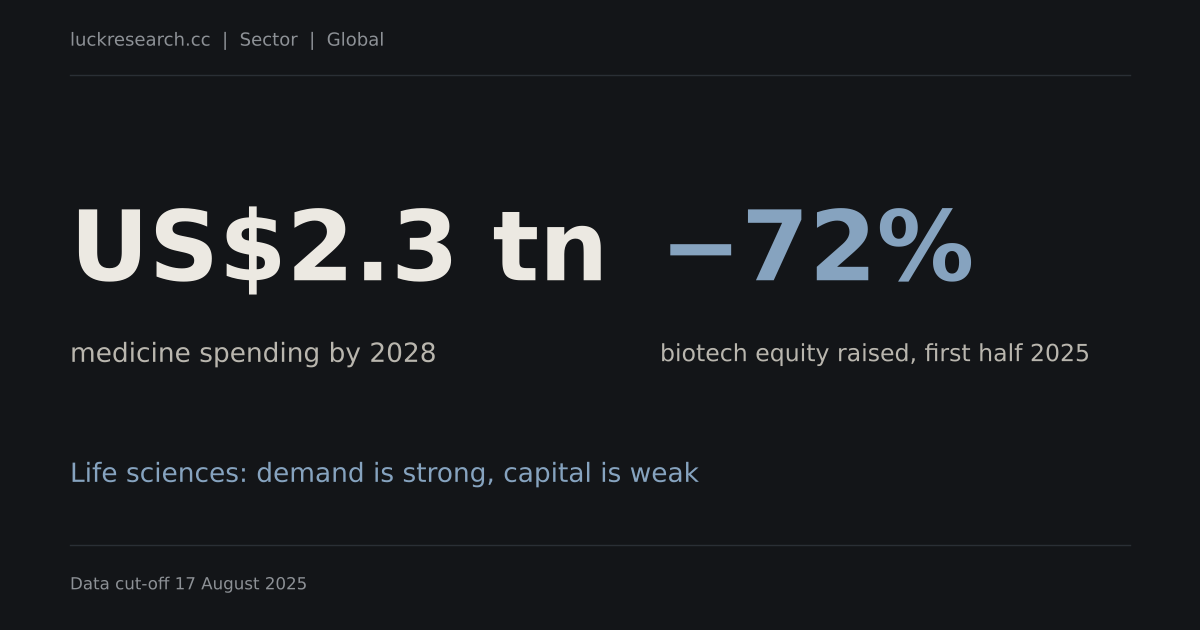
Life sciences is split: demand for medicines and contract manufacturing is strong, research services are mixed, and biotech funding and R&D productivity are weak.
Report Date: August 17, 2025
Analyst: R. MOH. SHAF HAL JAMIL
Published by: luckresearch.cc
Focus: Global Life Sciences (Biopharma, Contract Services, Tools, Diagnostics) | Analysis As Of: August 17, 2025
The Short Story
Global medicine spending should reach about US$2.3 trillion by 2028, growing 5–8% a year. Yet money for young biotech firms fell sharply in 2025, and lab-equipment sales are soft. The analyst scored eight parts of the industry: four have a positive level, two a negative level and two sit near zero. Only one is clearly rising: contract manufacturing.
Production and Industry Performance
- Medicines: a record 78 new active substances launched in 2024, but R&D productivity is still below its older level and programs take longer.
- Contract research: orders were 1.12 times revenue at one large firm, but its research segment grew only about 1% and another firm's backlog fell. The signal is mixed.
- Contract manufacturing: sales grew 23% in the first half, and makers raised their full-year guidance.
- Lab tools: organic sales averaged about -0.9% in the second quarter, with a wide spread between firms, as US academic labs and drug developers spent less.
- Diagnostics: evidence is thin. One large maker's sales fell as COVID testing faded and China bought in bulk, but were roughly flat without COVID tests.
Instrument sellers are the weakest. Sellers of consumables for drug production held up better, because those customers keep making medicines even when they cut research budgets.
Regions: US firms sponsor the most new trials and sell into the largest market. China started about 30% of new trials in 2024 and is a growing source of licensed drugs. Europe is slower but steady. The analyst has no verified data for Japan or India.
Prices, Demand, and Inventory
Obesity and diabetes drive much of the growth. Obesity spending may reach US$74 billion by 2028, about 25% a year. The two leading makers moved in opposite ways in the second quarter: one grew 38%, the other cut its 2025 outlook after competition and compounded (custom-mixed) versions of its drug.
Cancer and rare diseases are the next large areas. Most new gene-therapy trials target cancer (64% in the second quarter), and rare diseases made up 52% of 2024 US approvals. Immunology grows more slowly.
Biologics and copies: 118 biologic patents expire between 2025 and 2034, yet few copies are in development. This keeps pressure on prices without a fast wave of cheaper rivals.
Vaccines are a small part of total spending. US rules on COVID shots and cancelled federal mRNA projects hurt this part more than any other.
Capital is the weak link: biotech equity raising fell 72% in the first half of 2025 (one count; a narrower count gives -68%).
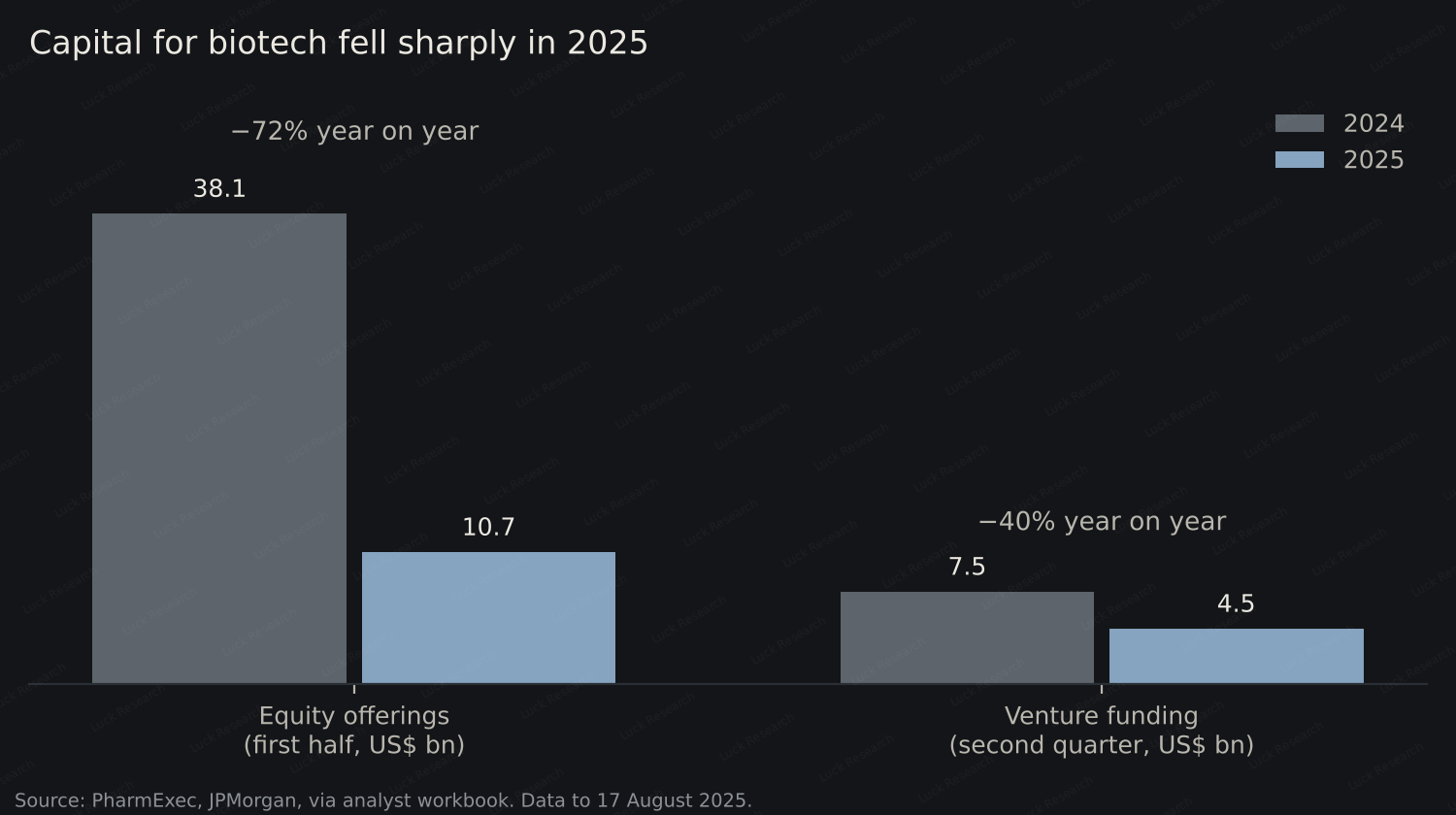
Source: PharmExec, JPMorgan. Data to August 17, 2025.
Patent expiries put about US$39 billion of big-pharma sales a year at risk, 21% of their R&D spending, which supports deals even when public markets are shut.
Policy and Regulation
US policy added doubt in 2025. The government capped indirect costs on research grants, ordered drug prices to move toward other rich countries, opened a tariff investigation on drug imports and narrowed the vaccine framework. A trade deal limited tariffs on EU goods. The tariff decision for drugs was still open at the cut-off.
Research grant cuts hurt tool sellers and academic labs. Price rules matter most for large drug makers. Tariffs matter most for firms that make drugs abroad.
Risks
Weak balance sheets are the main danger for small developers, because markets may stay shut for a while.
- Cash: 39% of biotech firms had under a year of cash in the 2024 data.
- Policy: pricing or tariff rules could cut demand and funding again.
- Obesity: one winner and one cut outlook show that growth can hide sharp competition.
- Data gaps: Europe, Japan, India, AI and several drug types have no verified numbers here.
- What would change the view: no US biotech listing through the third quarter, or contract research orders below revenue for two quarters in a row.
Industry Outlook
The analyst reads life sciences as having no single cycle. Confidence is low to medium, and diagnostics rests on one company.
Only contract manufacturing is rising. A biotech funding trough is forming but not confirmed, and diagnostics is too thin to call.
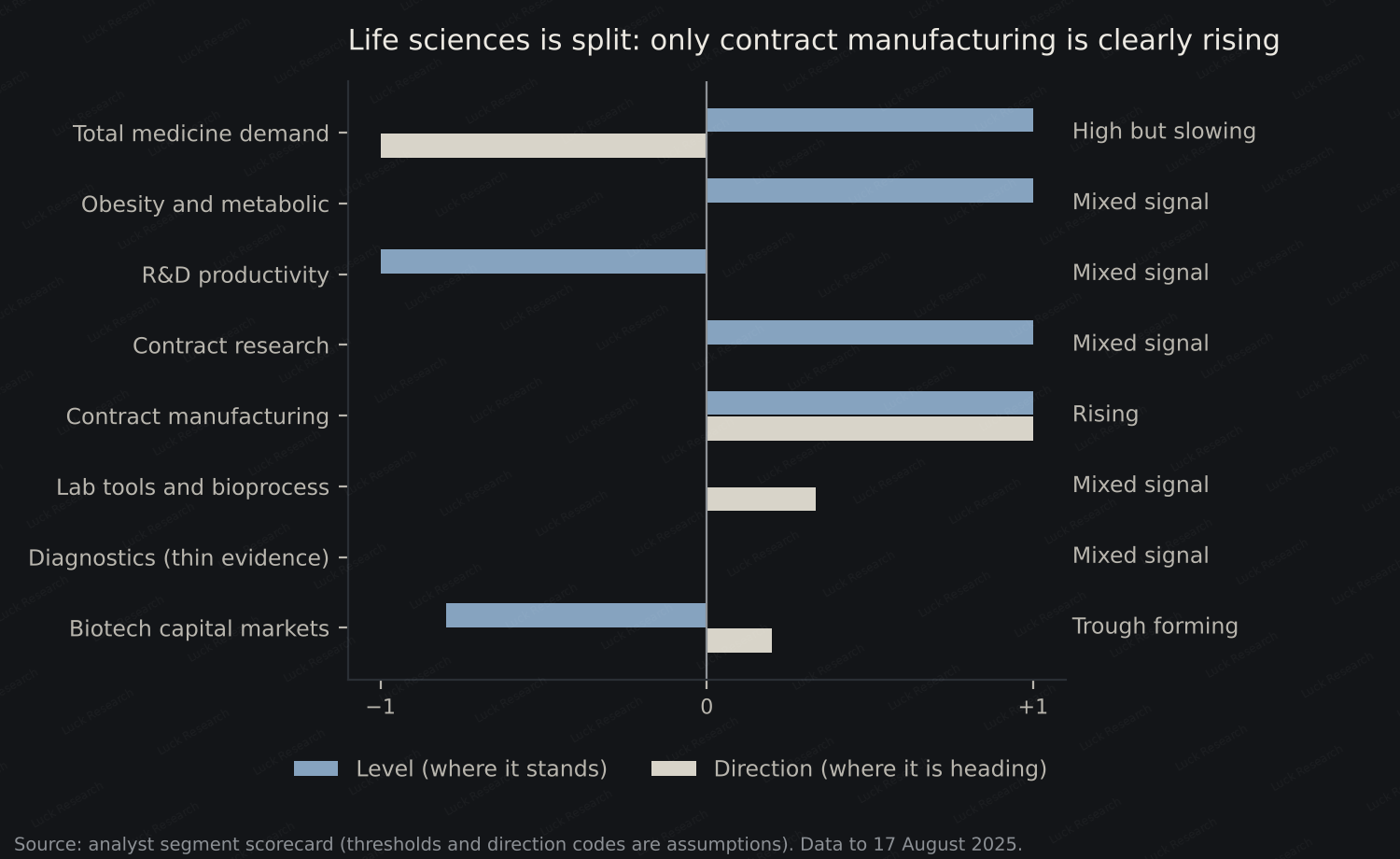
Source: analyst segment scorecard. Scores, thresholds and direction codes are assumptions. Data to August 17, 2025.
Three Paths From Here
These are what-ifs, not forecasts. In the bull path the IPO and deal window reopens. In the base path capital recovers in part. In the bear path US policy and interest rates press again.
| Path | Capital supply | Research services | Lab tools | Weight |
|---|---|---|---|---|
| Bull | +60% | +13.8% | +8.0% | 20% |
| Base | +20% | +9.8% | +4.0% | 50% |
| Bear | -15% | +6.3% | +0.5% | 30% |
The weights, the starting growth for research services (an average of two firms that differ widely) and the link from capital to growth are analyst assumptions.
What to Watch
- Tools: whether organic growth turns positive in the third quarter.
- Research services: whether orders stay above revenue and backlogs stop falling.
- Funding: any US biotech IPO, and equity raising above the second-quarter pace.
- Policy: US decisions on drug tariffs and pricing rules.
- Obesity: whether the cut outlook spreads to other makers.
Sources: IQVIA Institute, Global Trends in R&D 2025 (June 17, 2025) and Global Use of Medicines outlook (June 2025); JPMorgan, Q2 2025 Biopharma Licensing and Venture Report; William Blair, The Quarterly Rx Q2 2025; PitchBook, Q2 2025 VC Trends; PharmExec, Navigating Divergent Currents (August 15, 2025); Young & Partners, Pharma and Biotech M&A Review (August 11, 2025); Deloitte patent-cliff estimate via Biostock (March 18, 2025); ASGCT and Citeline, Q2 2025 gene, cell and RNA therapy report (August 1, 2025); company Q2 2025 earnings releases (July 17 to August 7, 2025), including Medpace and Danaher; analyst calculations.
Disclaimer: This report is for portfolio purposes only and should not be construed as investment advice. Investors should conduct their own research and consider their individual risk profiles before making any investment decisions. The author is not a licensed investment adviser. See the full disclaimer.
Detailed explanations are not available to the public. This note is not guaranteed to be revised or updated later.