
Cybersecurity Spending: July 2025 View Revisited
Since July 2025, spending forecasts rose and rules tightened. Three cyber indices rose more than the S&P 500, but only late and with deeper drops.
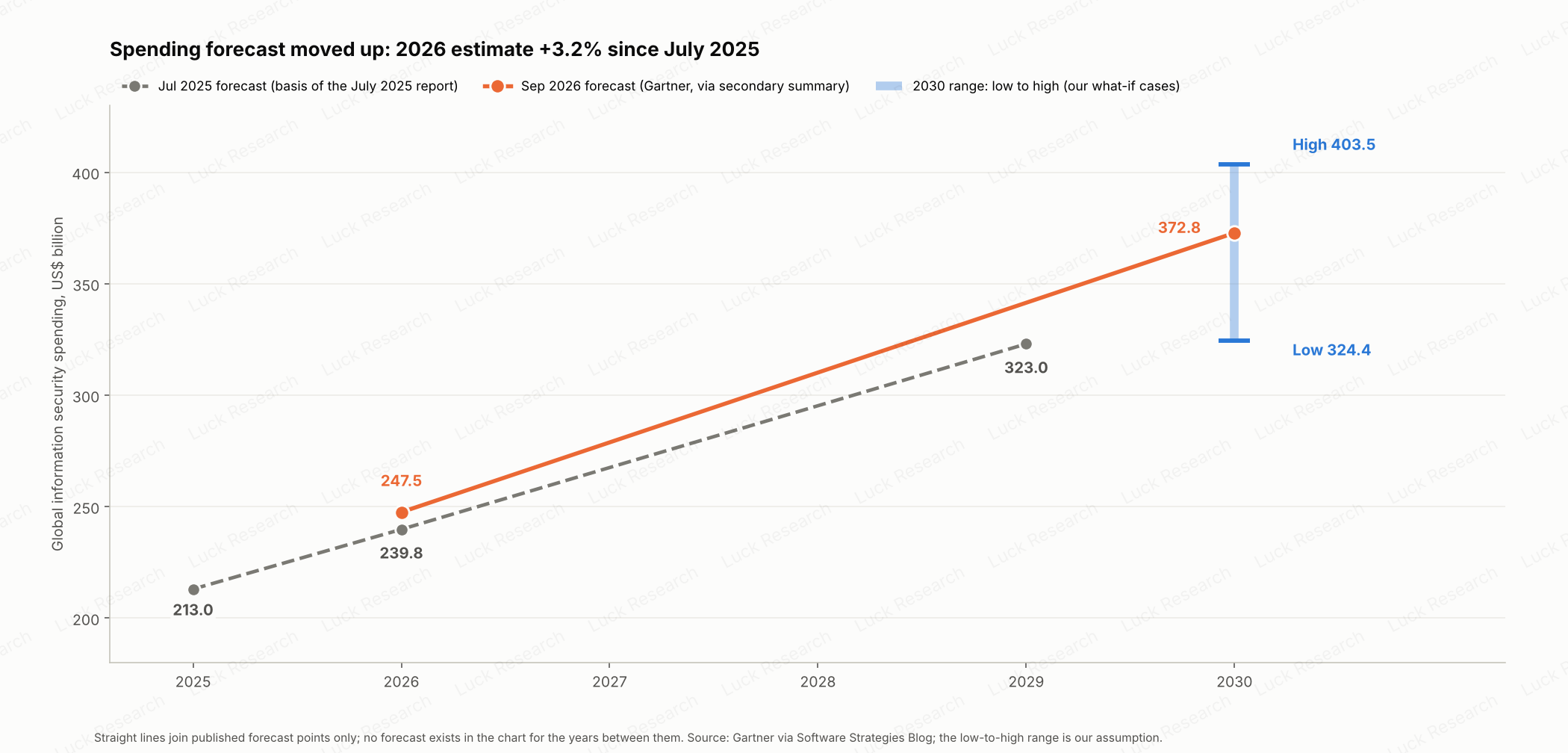
Since July 2025, security spending forecasts rose and rules got stricter, and cyber indices gained more than the S&P 500, but only late and with deeper drops.
Report Date: November 8, 2026
Analyst: R. MOH. SHAF HAL JAMIL
Published by: luckresearch.cc
Focus: Global Cybersecurity
The Short Story
In July 2025 the analyst wrote that security was becoming a recurring expense, but that market growth does not guarantee higher share prices. Both statements are consistent with the data so far. Forecasts moved up and regulators added duties. Prices followed, though late. The price test uses three Nasdaq cyber indices, not single stocks.
Spending and Industry Performance
Gartner's forecast, the base of the July 2025 report, shows almost unchanged growth at a higher level.
| July 2025 view | What happened since | Result |
|---|---|---|
| Spending grows at a double-digit pace | Implied growth of 10.8% a year to 2030, against 11.0% in July 2025 | Consistent |
| Forecasts get revised up | The 2026 estimate rose 3.2% to US$247.5 bn | Consistent |
| Rules make spending compulsory | EU incident reporting began on September 11, 2026 | Consistent |
| Skills scarcity pushes budgets to platforms | 59% report critical or significant skills needs, up from 44% | Consistent |
| Consolidation takes the spend | Palo Alto bought CyberArk, Google closed Wiz, ServiceNow bought Armis | Occurred |
| Growth does not guarantee returns | Cyber trailed the S&P 500 until spring 2026 | Consistent |
Source: Gartner via Software Strategies Blog; scenarios are analyst assumptions.
Vendor results agree. Four of five large vendors grew faster than the market's 13.6%.
Prices and Demand
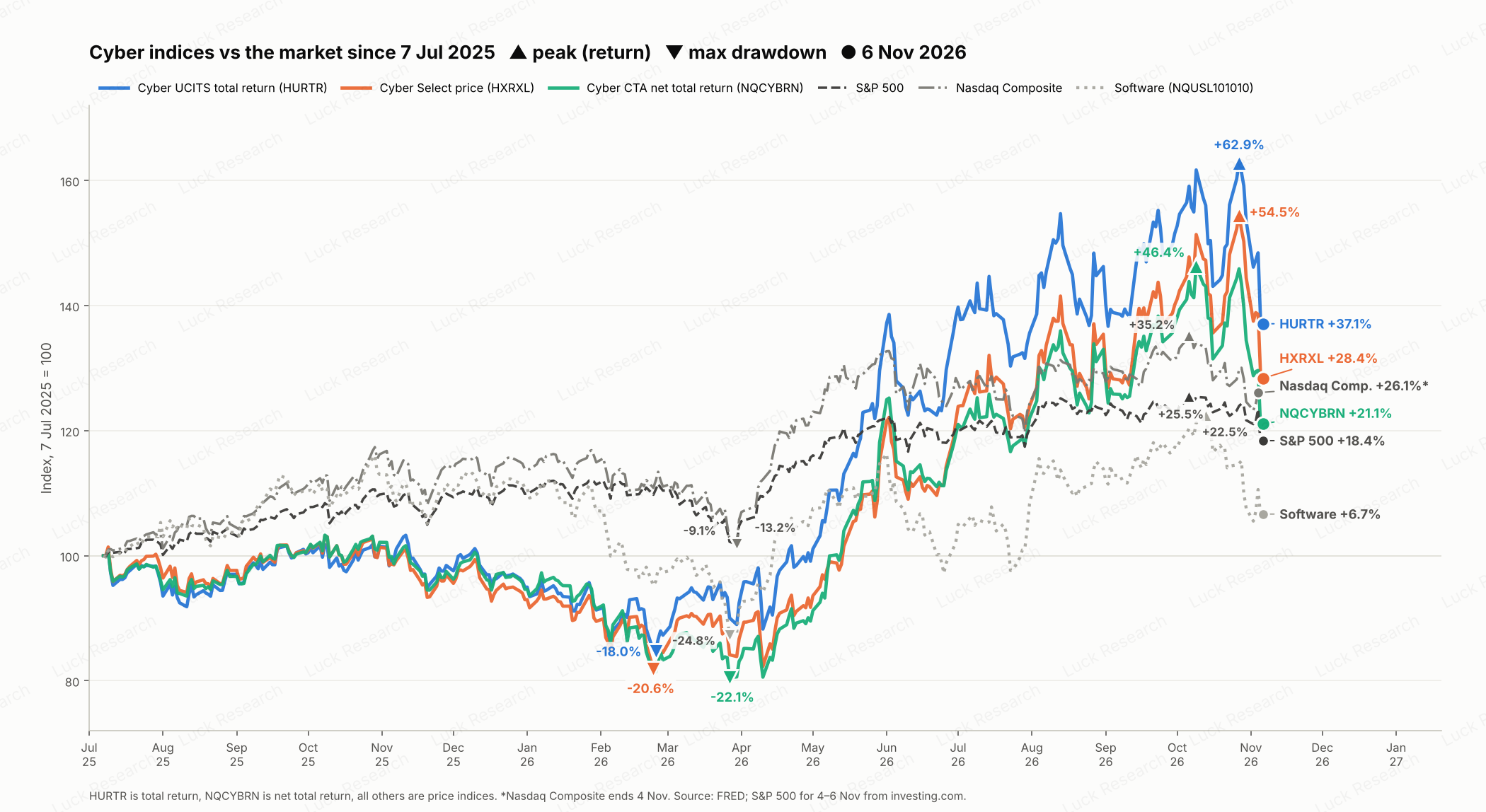
The test runs from July 7, 2025, the first trading day after the July 2025 report, to November 6, 2026. All three cyber indices gained more than the S&P 500 and a software index.
| Index | Type | Return | Max drop |
|---|---|---|---|
| HXRXL | Price | +28.4% | -20.6% |
| NQCYBRN | Net total return | +21.1% | -22.1% |
| HURTR | Total return | +37.1% | -18.0% |
| S&P 500 | Price | +18.4% | -9.1% |
| Software | Price | +6.7% | -24.8% |
Source: FRED (Nasdaq indices); S&P 500 for 4 to November 6 from investing.com.
The lead came late. Against the S&P 500, HXRXL sank to a ratio of 0.74 in February and peaked at 1.25 on October 27.
The October attack wave did not lift prices. Since October 9, NQCYBRN fell 17.2% and the S&P 500 fell 5.6%.
Budgets tell a similar story. IANS finds only 3% of CISOs cite a breach as the reason for more money, while new rules brought average increases of 22%.
Policy and Regulation
Rules, not headlines, are the steadier driver. The EU Cyber Resilience Act now requires incident reporting, and compliance with the NIS2 directive is still behind, so required spending is not used up. Indonesia has also issued a new personal data regulation, but its start date and penalties are not yet clear.
Risks
- Deeper drops: HXRXL fell as much as 20.6% from a peak, and the S&P 500 only 9.1%.
- End date: if the test had ended on November 3, HXRXL would show +38.9% instead of +28.4%.
- Not causal: the results do not show that attacks or spending caused the gains. AI stories and market mood moved prices too.
- Not single stocks: an index says little about any one company.
- What would change this reading: the HXRXL ratio falling below 1.0 while Gartner keeps raising forecasts, or a downward Gartner revision.
Industry Outlook
These are what-if cases for 2030 spending, not forecasts, and say nothing about any share price.
| Path | Trigger | Growth a year | 2030, US$ bn |
|---|---|---|---|
| High | Rules and attacks lift budgets | 13% | 403.5 |
| Middle | Gartner's forecast | 10.8% | 372.8 |
| Low | Budgets held back | 7% | 324.4 |
Data to follow: the next Gartner revision, the HXRXL ratio against 1.0, and the median CISO budget.
Note: Gartner, IANS and rules data come from secondary sources, and the three spending paths are assumptions.
Sources: FRED (NASDAQHXRXL, NASDAQNQCYBRN, NASDAQHURTR, NASDAQNQUSL101010, SP500, NASDAQCOM, NASDAQ100); investing.com (S&P 500, 4 to November 6); Gartner via Software Strategies Blog; ISC2 (2025 Workforce Study); IANS; Reed Smith; company releases; SDxCentral; Windsor Drake; Bisnis.com; analyst calculations.
Disclaimer: This report is for portfolio purposes only and should not be construed as investment advice. Investors should conduct their own research and consider their individual risk profiles before making any investment decisions. The author is not a licensed investment adviser. See the full disclaimer.
Detailed explanations are not available to the public. This note is not guaranteed to be revised or updated later.