
Indonesia Cybersecurity Overview: Demand Clear, Data Thin
Indonesia's digital economy is growing and rules are tightening, but verified spending data is thin and public-sector budgets are under pressure.
Indonesia's digital economy is expanding and data-protection rules are tightening, but verified spending data is scarce and public-sector budgets are under pressure, so demand will be shaped by enforcement and procurement, not just by risk awareness.
Report Date: July 6, 2025
Analyst: R. MOH. SHAF HAL JAMIL
Published by: luckresearch.cc
Focus: Cybersecurity industry in Indonesia
Market Structure and Industry Performance
APJII's preliminary figure put Indonesian internet users at about 225 million in 2024, up from roughly 221 million. Google, Temasek, and Bain's e-Conomy SEA report (November 13, 2024) estimated Indonesia's digital economy at about US$90 billion in GMV in 2024, up 13%, the largest in Southeast Asia, and expected it to double by 2030. Digital payments reached US$404 billion in gross transaction value (+19%).
More transactions and more stored personal data mean a larger attack surface and a larger compliance burden.
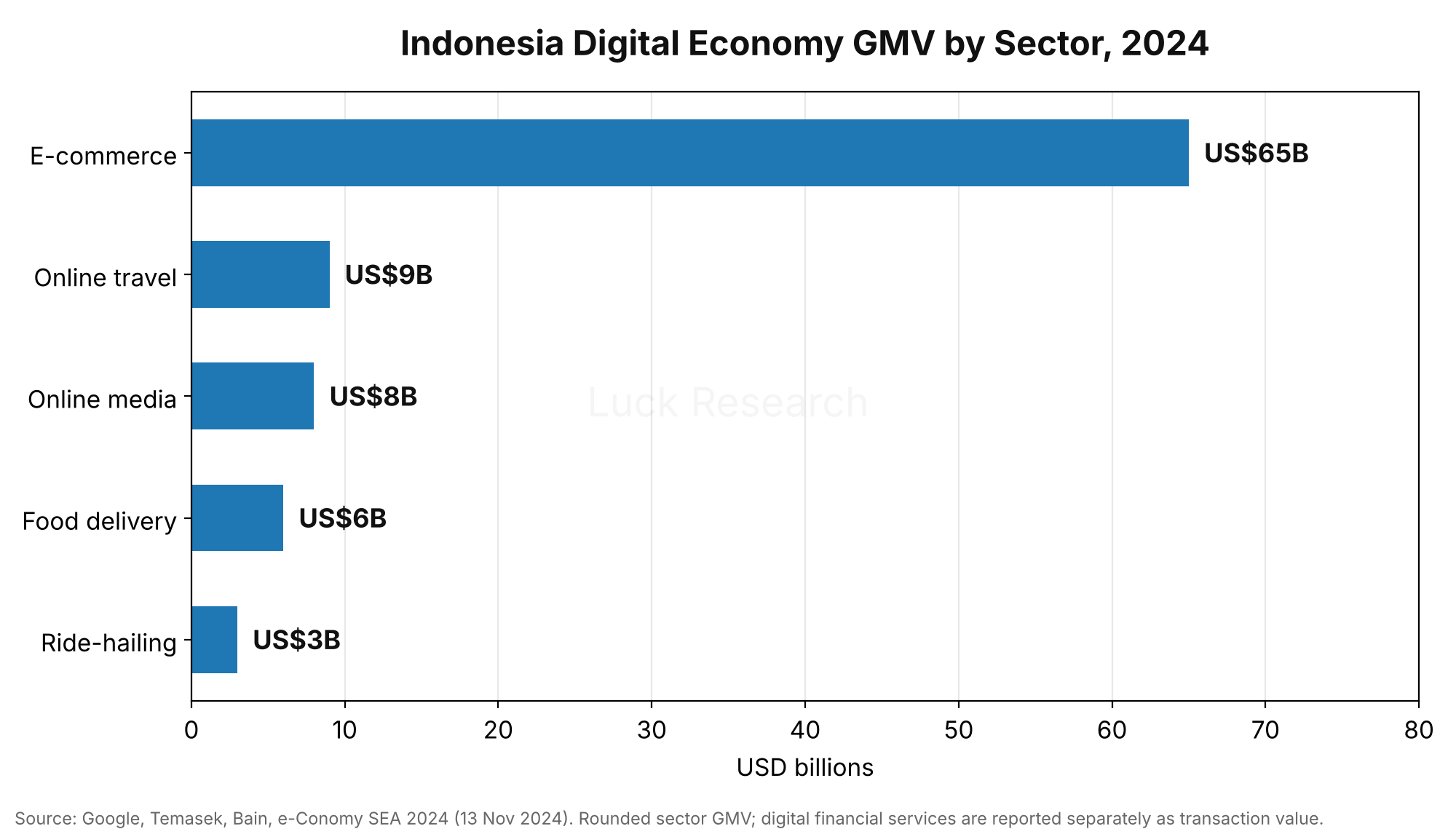
Source: Google, Temasek, and Bain, e-Conomy SEA 2024 (November 13, 2024). Rounded sector GMV; digital financial services are reported separately as transaction value.
For context, Gartner forecasts global security spending of US$213 billion in 2025 and US$323 billion in 2029. The supply side is a mix of global subscription-software vendors, local integrators and managed-service providers, and telecom and data-center operators.
Demand: Incidents, Banking, and Digital Finance
The clearest incident was the June 2024 ransomware attack on the Temporary National Data Center (PDNS). Per Kominfo, attackers disabled Windows Defender and deleted file-storage applications between June 17 and 20, and problems surfaced on June 20. Immigration services were disrupted and restored on June 24, while 282 other ministries, agencies, and departments were being restored from a backup data center.
The episode showed the cost of concentrating government data and raised the visibility of backup, endpoint, and identity controls.
Finance is the other pull. With digital payments at US$404 billion, commercial banks (conventional and sharia) operate under OJK circular SEOJK 29/SEOJK.03/2022, effective December 27, 2022, which supplements POJK 11/2022 on IT risk management.
It requires a cyber-security function independent from operational IT, an annual cyber risk assessment, penetration testing plus scenario-based exercises, and incident reporting: early notification within 24 hours and a full report within five working days.
Those recurring obligations create steady demand for testing, monitoring, and incident response services, which is the analyst's inference rather than a measured spending figure.
Policy and Regulation
The Personal Data Protection Law (Law No. 27 of 2022) was enacted on October 17, 2022 and took full effect by October 17, 2024.
As of October 14, 2024, the supervisory authority had not been established; Kominfo was to oversee data protection in a transition expected to last six to twelve months, and Bisnis.com reported in January 2025 that an interim authority would sit within the ministry's digital-space supervision unit. The obligation exists, but enforcement capacity is still maturing, which can delay spending.
Presidential Regulation 82 of 2022 (signed May 24, 2022) covers vital information infrastructure in eight sectors: government administration, energy, transportation, finance, health, ICT, food, and defense. BSSN coordinates protection and operators must form incident response teams.
Budgets and Procurement
Public demand is not guaranteed. Metro TV (February 14, 2025) reported that BSSN's budget of Rp1.32 trillion was cut by Rp538.6 billion in the 2025 efficiency drive, leaving about Rp781 billion by the analyst's calculation.
The analyst's assessment, not verified against procurement data, is that many Indonesian buyers rely on integrators and local distributors and that skilled security staff are scarce, which favors services and managed security over pure software subscription.
Risks
- Public-sector budget pressure: BSSN's cut shows cybersecurity is not exempt from efficiency programs.
- Enforcement lag: a data-protection authority still being set up weakens the compliance push.
- Services economics: project-based revenue is lumpier and less scalable than subscription ARR, which limits how closely Indonesian industry growth tracks global software growth.
- Data gaps: without a verified domestic market-size series, any growth estimate would rest on assumptions rather than measurement.
Industry Outlook
The analyst's base case is that Indonesian demand grows with digitalization, digital payments, and compliance, but monetization is gradual and led by services rather than subscription software.
The speed of conversion depends on how quickly the data-protection authority begins enforcing, how banking and vital-infrastructure rules translate into procurement, and whether public budgets recover. The analyst monitors the PDP authority and its enforcement, OJK and BSSN requirements, BSSN's budget and procurement, and incident disclosures at banks and government agencies.
Sources: APJII internet user data via Bisnis.com (January 23, 2025); Google, Temasek, and Bain, e-Conomy SEA 2024 (November 13, 2024); TEISS, PDNS ransomware attack (June 2024); OJK, SEOJK 29/SEOJK.03/2022 (effective December 27, 2022) via KPMG Indonesia newsflash (January 2023); Law No. 27 of 2022; Bisnis.com on PDP supervisory body (October 14, 2024 and January 2025); Setkab, Presidential Regulation 82/2022 (June 15, 2022); Metro TV, efficiency budget cuts (February 14, 2025); Gartner, Forecast: Information Security, Worldwide, 2023–2029, 2Q25 Update (June 24, 2025).
Disclaimer: This report is for portfolio purposes only and should not be construed as investment advice. Investors should conduct their own research and consider their individual risk profiles before making any investment decisions. The author is not a licensed investment adviser. See the full disclaimer.
Detailed explanations are not available to the public. This note is not guaranteed to be revised or updated later.