
Indonesia Green Energy: Demand Rises, Delivery Decides
RUPTL sees power sales at 511 TWh by 2034 and plans 42.6 GW of renewables. Geothermal, hydro and solar lead, but delivery and grid readiness decide results.
Indonesia expects power sales to grow from 306 TWh to 511 TWh by 2034, but only projects with contracts, financing and grid access will benefit.
Report Date: December 31, 2025
Analyst: R. MOH. SHAF HAL JAMIL
Published by: luckresearch.cc
Focus: Renewable power industry in Indonesia
Data cut-off: December 31, 2025
Production and Industry Performance
IRENA records Indonesia's renewable capacity at 14,295 MW at the end of 2024, about 14% of the 100.65 GW national power capacity. The Ministry of Energy (ESDM) reports 14,877 MW, but its series includes 450 MW of coal gasification, so the analyst uses IRENA for growth and ESDM only for policy tracking.
| Period (IRENA series) | Beginning (MW) | Ending (MW) | Intervals | CAGR |
|---|---|---|---|---|
| Full period: 2015 to 2024 | 8,575 | 14,295 | 9 | 5.84% |
| 2019 to 2024 | 10,303 | 14,295 | 5 | 6.77% |
| 2021 to 2024 | 11,533 | 14,295 | 3 | 7.42% |
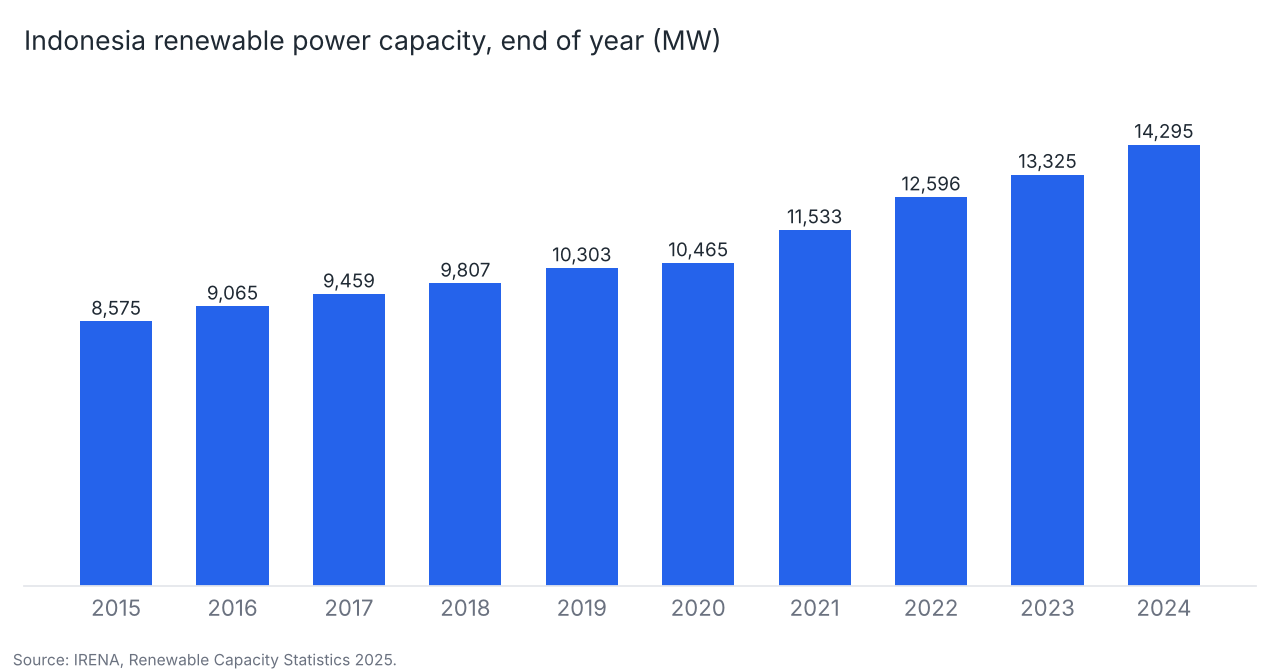
Source: IRENA, Renewable Capacity Statistics 2025.
Indonesia grows more slowly than the world (10.23% full period), but the pace is rising.
In H1 2025, ESDM reported 876.5 MW of new renewable capacity (mainly hydro 492 MW, solar 233 MW and geothermal 105 MW), more than the 761.9 MW added in all of 2024. Renewables were 14.68% of the primary energy mix in 2024 (13.29% in 2023). This is not an electricity share, and ESDM says the 2024 figure still needs adjustment.
Prices, Demand, and Investment
RUPTL sees PLN electricity sales rising from 306 TWh in 2024 to 511 TWh in 2034, an extra 205 TWh (analyst's implied CAGR: 5.26%). In 2024 use per person was 1,411 kWh, there were 92.88 million customers, the electrification ratio was 99.83% and grid losses were 8.58%. ESDM names industrial estates, downstreaming, data centers and tourism as drivers but gives no TWh split.
Heavy loads from smelters, industrial estates and data centers are concentrated in a few places, so transmission and substations matter as much as new plants. Higher demand helps renewables only if they win contracts and the grid can take their power.
Renewable investment was USD 1.767 billion in 2024, and USD 0.8 billion in H1 2025 against USD 0.565 billion a year earlier (+42%). The analyst did not find an Indonesian PPA tariff or LCOE benchmark, so global LCOE should not be used as a local tariff.
Policy and Regulation
RUPTL 2025 to 2034 plans 69.5 GW of new capacity: 42.6 GW renewable (including 0.5 GW nuclear), 10.3 GW storage and 16.6 GW fossil, with about USD 188 billion of investment. Renewables are solar 17.1 GW, hydro 11.7 GW, wind 7.2 GW and geothermal 5.2 GW. Storage is 6.0 GW of batteries plus 4.3 GW of pumped storage.
RUPTL also targets almost 48,000 circuit km of transmission and about 108,000 MVA of substations. It is a plan, not a set of contracts with financial close.
Risks
- Execution: the RUEN target of 23% renewables in 2025 looks out of reach. ESDM projected a 14.4% power mix for end-2025, below the 15.9% RUKN target.
- Grid and offtaker: transmission can lag generation, and PLN's finances limit how much it can contract.
- Financing and currency: USD debt with rupiah revenue can hurt project returns.
- Demand uncertainty: data center forecasts can change with chip efficiency and server use.
- Data definitions: ESDM and IRENA series differ and should not be mixed.
Industry Outlook
The analyst's base case is steady but slower-than-planned growth, led by geothermal, hydro and solar, with storage and transmission following. If all 42.1 GW of planned renewables were built by 2034, capacity would grow about 14.7% per year, against 5.84% in 2015 to 2024. This is a full-delivery scenario, not a forecast.
The analyst watches tender awards, PPA signings, final investment decisions, project start dates, transmission progress and large new load connections.
Top 3 Sub-Industries to Monitor
The ranking is a monitoring priority, not a buy recommendation.
- Geothermal: RUPTL plans 5.2 GW. Stable baseload from a domestic resource. Risks: exploration, drilling cost and upfront capital. Listed exposure: PGEO, BREN.
- Hydropower: RUPTL plans 11.7 GW, and it helps balance variable power. Risks: long build times, land and environmental issues, hydrology. Listed exposure: KEEN, ARKO.
- Solar PV: RUPTL plans 17.1 GW, the largest block. It is quick to build but needs grid and storage support. No clear listed solar pure-play is identified.
Grid and storage are enablers to monitor, not top 3, because no listed Indonesian pure-plays are identified.
Sources: Kementerian ESDM, Statistik Ketenagalistrikan 2024; Kementerian ESDM, FAQ RUPTL PLN 2025 to 2034; Kementerian ESDM, RUPTL 2025 to 2034 presentation materials; Kementerian ESDM, Laporan Kinerja Ditjen EBTKE 2024; Kementerian ESDM, H1 2025 sector performance press conference (August 2025); Kontan and Bisnis reports on the 2025 renewable mix (June to August 2025); IRENA, Renewable Capacity Statistics 2025. CAGR figures and the full-delivery scenario are the analyst's calculations.
Disclaimer: This report is for portfolio purposes only and should not be construed as investment advice. Investors should conduct their own research and consider their individual risk profiles before making any investment decisions. The author is not a licensed investment adviser. See the full disclaimer.
Detailed explanations are not available to the public. This note is not guaranteed to be revised or updated later.