
Global Cybersecurity Overview: Spending Turns Recurring
Security spending is forecast at US$323B by 2029 as AI-speed attacks and quantum-safe mandates make it recurring; vendor selection still decides returns.

AI is compressing the time defenders have, quantum mandates are setting a migration deadline, and regulation is making both compulsory: cybersecurity is becoming a recurring corporate expense, but market growth does not automatically translate into higher share prices.
Report Date: July 6, 2025
Analyst: R. MOH. SHAF HAL JAMIL
Published by: luckresearch.cc
Focus: Global cybersecurity industry
Market Size and Industry Performance
Gartner (June 24, 2025) forecasts global information security spending of US$213 billion in 2025 and US$323 billion in 2029, an implied CAGR of about 11.0%.
This is end-user spending across the whole market (software, services, and network security), not revenue that pure-play vendors can capture in full. Cybersecurity Ventures' US$454 billion estimate for 2025 includes cyber insurance and military cyber defense, so it is not comparable.
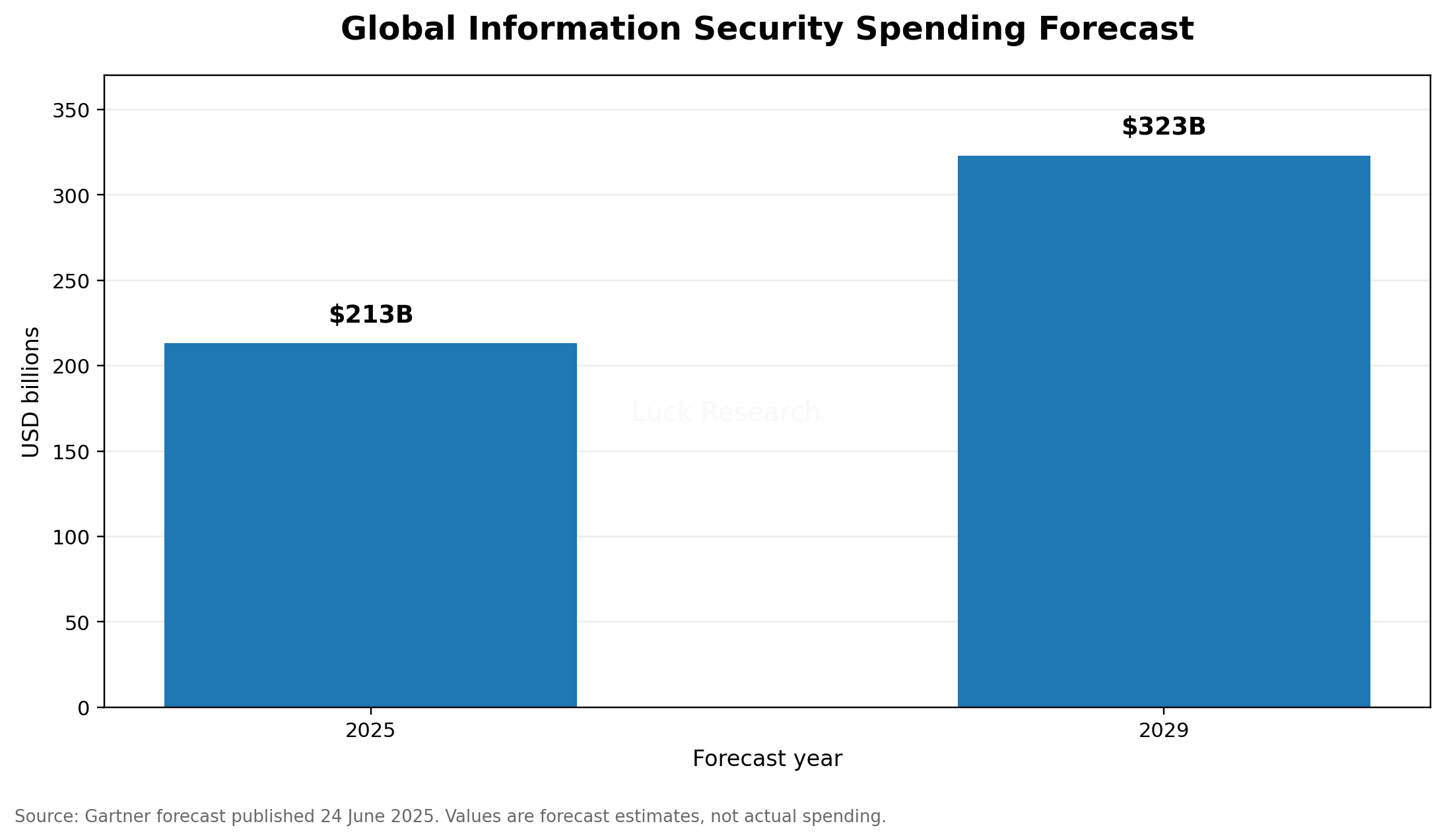
Source: Gartner, forecast published June 24, 2025. Values are forecasts, not actual spending.
The six large listed security vendors the analyst reviewed grew revenue 12% to 25% year on year in their latest quarter before the cut-off. The three that disclose ARR showed growth of 23% to 34%, against a forecast market CAGR of 11.0%.
Capital is also moving: a large technology group agreed to buy a leading cloud-security platform for US$32 billion in cash (March 18, 2025), citing AI and cloud adoption.
Demand Drivers: Breaches, AI, and Quantum
Breaches have a price. Verizon's 2025 DBIR counted 12,195 confirmed breaches across 139 countries, with ransomware in 44% (up 37%). IBM puts the average breach at US$4.88 million (2024, +10%).
AI shortens the response window. A 2025 vendor threat report (February 27, 2025) found an average eCrime breakout time of 48 minutes, with the fastest at 51 seconds; voice phishing rose 442% between the first and second half of 2024, tied to AI-driven impersonation, and 79% of initial access was malware-free. Humans alone cannot respond at that speed, so spending shifts toward automated detection and response.
IBM found breaches cost about US$1.9 million less (US$3.84M vs US$5.72M) at organizations using security AI and automation extensively, while 53% reported a critical shortage of security staff, up from 42%. Skills scarcity and AI efficiency both push budgets toward platforms and managed services.
Quantum sets a migration deadline. NIST finalized its first post-quantum encryption standards on August 13, 2024 and urged administrators to start transitioning. Its November 2024 draft (IR 8547) proposes deprecating RSA-2048-class algorithms after 2030 and disallowing quantum-vulnerable algorithms by 2035; the NSA's CNSA 2.0 targets exclusive use of quantum-resistant algorithms for cloud services and browsers by 2033. Gartner has warned that traditional asymmetric cryptography could become unsafe by 2029.
This is a multi-year replacement cycle for certificates, keys, VPNs, and identity systems. It is long-dated, so the analyst treats it as option value rather than near-term revenue.
Competition and Where Value Sits
Subscription software vendors capture value best: recurring revenue, high switching costs, strong gross margins. Managed services grow but with thinner margins. Competition is intense: large technology platforms and the hyperscalers have broad distribution, and customers are consolidating vendors into fewer platforms. Sub-industries to monitor: endpoint detection and response (EDR/XDR), cloud security and zero trust (SASE), and identity security.
Policy and Regulation
SEC rules require disclosure of material incidents on Form 8-K within four business days, EU NIS2 had a transposition deadline of October 17, 2024, and EU DORA has applied to finance since January 17, 2025. Domestic exposure in Indonesia is covered in the separate Indonesia industry overview.
Risks
- Platform consolidation: total budgets can grow while fewer vendors receive them.
- Bundling and AI commoditization: bundling by large technology groups and easier-to-copy AI security features pressure pricing and margins; AI helps attackers as well as defenders.
- Quantum timing: standards are set, but adoption pace and who captures the spend are unproven.
- Valuation and dilution: growth already priced in, plus stock-based compensation, can erode per-share returns.
Industry Outlook
The analyst's base case is that security spending keeps growing at a structural double-digit pace, with AI and the post-quantum transition adding demand layers on top of breaches and regulation. Only vendors with differentiated products, high retention, and improving free cash flow should grow faster than the market, and industry growth alone does not prove pure-play stocks will outperform, since that depends on consensus expectations and the price paid.
The analyst monitors ARR and net new ARR, net revenue retention, FCF margin, share dilution, post-quantum procurement signals, and revisions to Gartner's forecast.
Sources: Gartner, Forecast: Information Security, Worldwide, 2023–2029, 2Q25 Update (June 24, 2025); Verizon, 2025 DBIR; IBM, Cost of a Data Breach Report 2024 (July 30, 2024; AI-savings and skills figures via SOCRadar summary); CrowdStrike, 2025 Global Threat Report (February 27, 2025); earnings releases of six listed security vendors (March–May 2025); Alphabet 8-K (March 18, 2025); NIST post-quantum standards release (August 13, 2024) via quantum.gov; NIST IR 8547 initial public draft (November 2024); NSA CNSA 2.0 timeline; Gartner post-quantum commentary (October 2024); SEC cybersecurity disclosure rules (2023); EU NIS2 and DORA; Cybersecurity Ventures.
Disclaimer: This report is for portfolio purposes only and should not be construed as investment advice. Investors should conduct their own research and consider their individual risk profiles before making any investment decisions. The author is not a licensed investment adviser. See the full disclaimer.
Detailed explanations are not available to the public. This note is not guaranteed to be revised or updated later.