
Will MSCI downgrade Indonesia? What 12 cases say
10 of 12 MSCI downgrade processes ended in a downgrade. Across ten methods, the analyst puts Indonesia's odds at about 65% to 80%.
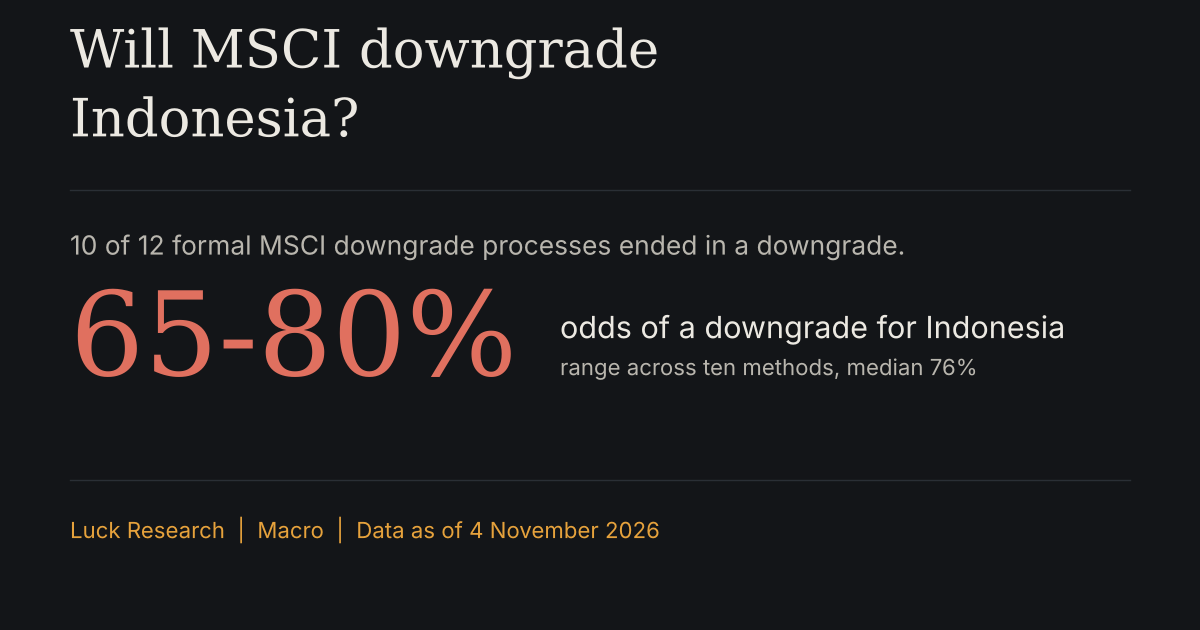
10 of 12 formal MSCI downgrade processes ended in a downgrade. The analyst puts the odds of a downgrade for Indonesia at about 65% to 80%, but the evidence is thin.
Report Date: November 4, 2026
Analyst: R. MOH. SHAF HAL JAMIL
Published by: luckresearch.cc
Focus: MSCI proposal to move Indonesia from Emerging to Standalone
The Catalyst vs. The Trend
On October 15, 2026, MSCI proposed to move Indonesia from Emerging to Standalone status. It will decide by June 30, 2027. The IDX Composite fell more than 11% on October 16, and trading halted. That day, OJK fined parties linked to DSSA, BREN and CUAN a combined Rp2.1 trillion.
On the same day, MSCI froze index changes for Turkey over similar concerns. That is a warning, not a formal process, and no other downgrade process is open.
The trend: 12 formal MSCI processes since 2006 to cut a market's status, 10 ended in a downgrade.
The Timeline
| Country | Process | Proposal | Result |
|---|---|---|---|
| Venezuela | 2006 | Emerging to Standalone | Downgrade |
| Argentina I | 2008-2009 | Emerging to Frontier | Downgrade |
| Greece | 2012-2013 | Developed to Emerging | Downgrade |
| Morocco | 2012-2013 | Emerging to Frontier | Downgrade |
| Ukraine | 2015 | Frontier to Standalone | Downgrade |
| Peru | 2015-2016 | Emerging to Frontier | Kept |
| Nigeria I | 2016-2017 | Frontier to Standalone | Kept |
| Argentina II | 2019-2021 | Emerging to Standalone | Downgrade |
| Lebanon | 2020-2021 | Frontier to Standalone | Downgrade |
| Pakistan | 2021 | Emerging to Frontier | Downgrade |
| Russia | 2022 | Emerging to Standalone | Downgrade |
| Nigeria II | 2022-2023 | Frontier to Standalone | Downgrade |
| Indonesia | 2026 | Emerging to Standalone | Open |
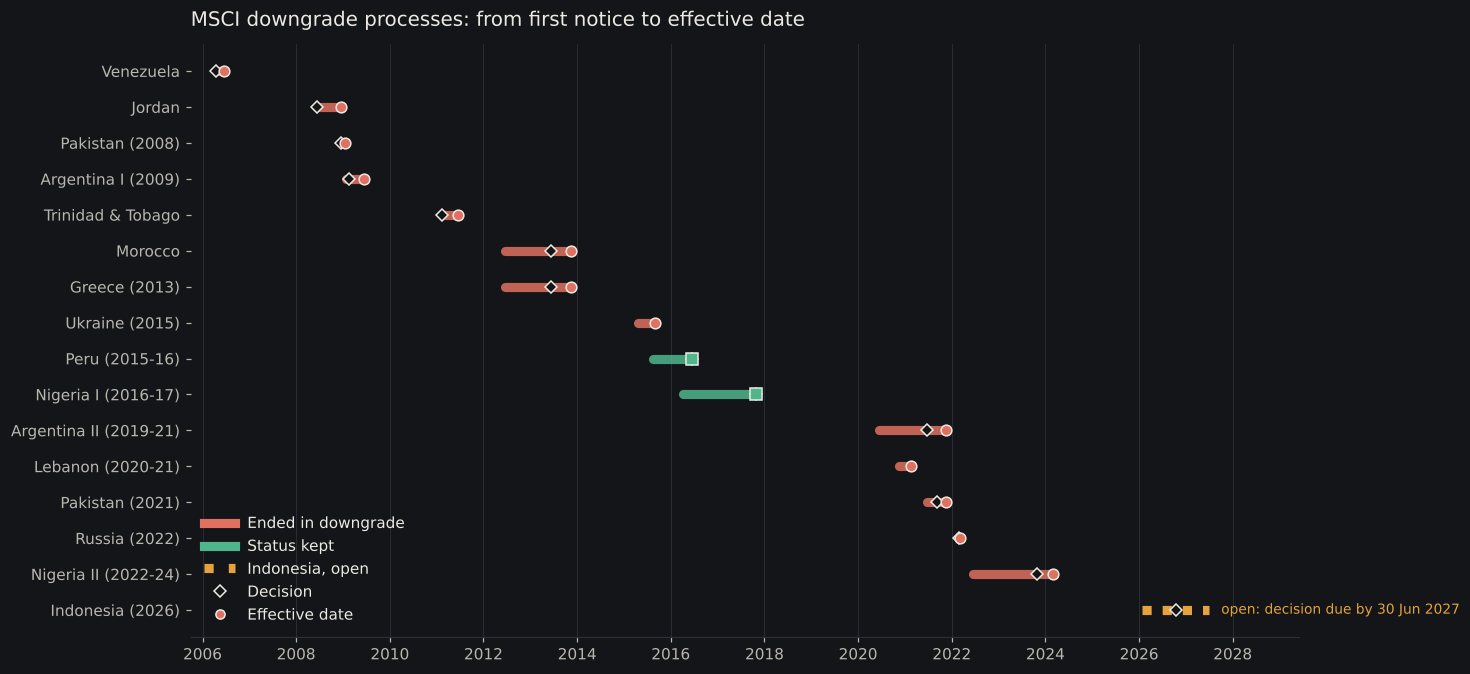 Source: MSCI releases; NBER working paper w23557; press reports.
What the Numbers Say
- Base rate: 10 of 12 is 83%, with a 95% Clopper-Pearson interval of 52% to 98%. With so few cases, the range matters more than the point.
- Cases most like Indonesia: processes lasting nine months or more ended in a downgrade 4 times out of 6.
- Analyst scorecard: the base rate adjusted for Indonesia's facts gives 79%, from 45% (optimistic) to 93% (pessimistic).
- All methods: ten methods give a middle result of 76%, ranging from 54% to 84%. The odds are about 65% to 80%.
The weights are the analyst's judgment, not data estimates. Upward: MSCI says it will proceed unless it sees clear evidence. Downward: the cause can be fixed by policy, size is not the issue, and authorities responded to all six MSCI concerns.
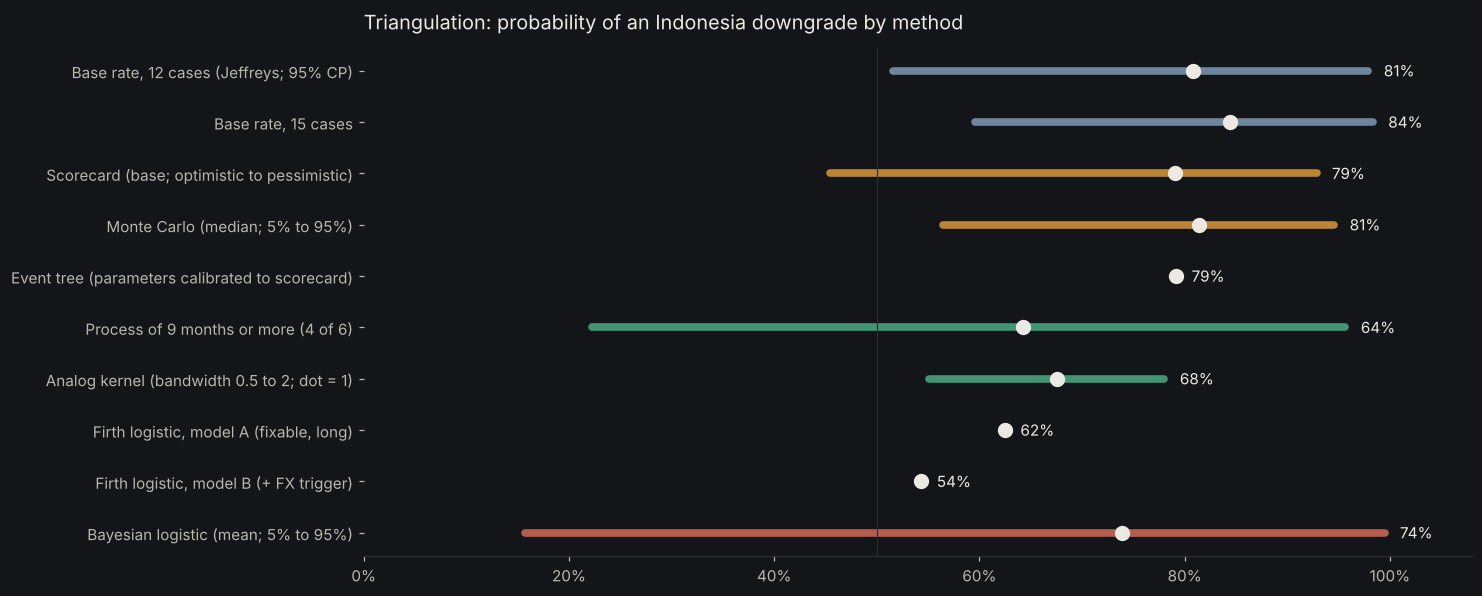 Source: analyst's calculation. Dot is the point estimate. Bars show intervals or ranges where the method gives one. Methods using cases like Indonesia give lower odds than base rates.
Where It Does Matter
Two cases survived, by different routes.
- Nigeria, 2016-2017: FX liquidity was poor. A new FX window opened in April 2017, and MSCI dropped the review in October 2017.
- Peru, 2015-2016: liquidity fell below Emerging levels, but MSCI kept Peru because the index still had three constituents.
Indonesia's case is about market integrity. Authorities report disclosure of holders above 1% since March, a public list of concentrated stocks since April, and a 15% minimum free float. OJK named more cases on October 31, and at least 835 parties faced enforcement from January to October.
MSCI's October 15 statement came before these fines and has not reviewed them. Size is not the issue: the index has 9 constituents.
Analyst View
A downgrade is the likely outcome, but it is not settled. The reforms are announced and enforcement has started. MSCI now wants proof that they work across the whole market.
In the analyst's model, visible proof lifts the chance of keeping the status from 21% to about 34%, and above 50% if everything goes right. The analyst hopes Indonesia stays in Emerging, but that hope is not in the numbers.
What to Watch
- Evidence of impact: enforcement against coordinated trading beyond the largest stocks, and a verified free float ramp-up.
- Politics: on October 21 the president called MSCI's move an attempt to intimidate Indonesia. MSCI says its decisions follow rule-based methods.
- Turkey: MSCI gave Turkey until June 2027 and Indonesia a consultation. Watch whether the November 2026 review changes that gap.
- Timing: past downgrades took effect about four months after the decision, so likely August or November 2027. This is when, not whether.
- Limits: 12 to 15 cases and two exceptions with different causes. A machine-learning test did not beat the simple base rate.
Sources: MSCI (Indonesia consultation, October 15, 2026; Turkey freeze, October 15, 2026; 2026 Market Classification Review, June 23, 2026; releases on Peru, Ukraine, Pakistan and Russia); NBER working paper w23557; KabarBursa (Stockbit, October 16, 2026); CNBC Indonesia (October 16, 2026); CNN Indonesia (November 4, 2026); Bloomberg Technoz (October 27 and 31, 2026); Jakarta Post and Reuters (October 21, 2026); Perú Reports. Calculations by the analyst, data as of November 4, 2026.
Disclaimer: This report is for portfolio purposes only and should not be construed as investment advice. Investors should conduct their own research and consider their individual risk profiles before making any investment decisions. The author is not a licensed investment adviser. See the full disclaimer.
Detailed explanations are not available to the public. This note is not guaranteed to be revised or updated later.